

The Healing Power of the Arts: Longevity, Immunity & Wellbeing
Within society we seem to have separated the arts out, so they’re not so much a part of our daily lives. As I’ve become a mother and I have children now, it’s been really eye-opening to rediscover lots of arts things that I’d stopped doing in my own childhood. But now coming back to them I think probably the most meaningful one for me is one I describe in the book, which is about my younger daughter, Daphne, who was premature and unfortunately got incredibly ill with meningitis and was in intensive care when she was just a few days old.
I felt so helpless in that situation about what I was supposed to do. I couldn’t even touch her, but I realized I could use my voice. So I sang to her day after day as a way of connecting with her, but also as a way of helping to relax her, to try and reduce the stress and pain that she was going through. And actually, I could see on the monitors that when I sang to her, she had these reductions in her blood pressure. She had these improvements in her oxygen saturation, actually benefits that I’d read about in scientific studies before then. But it was so exciting to actually see this happening in the real world, and for me it was the most memorable and poignant moment in the arts that I’ve ever had of actually seeing how vital they could be in those moments.
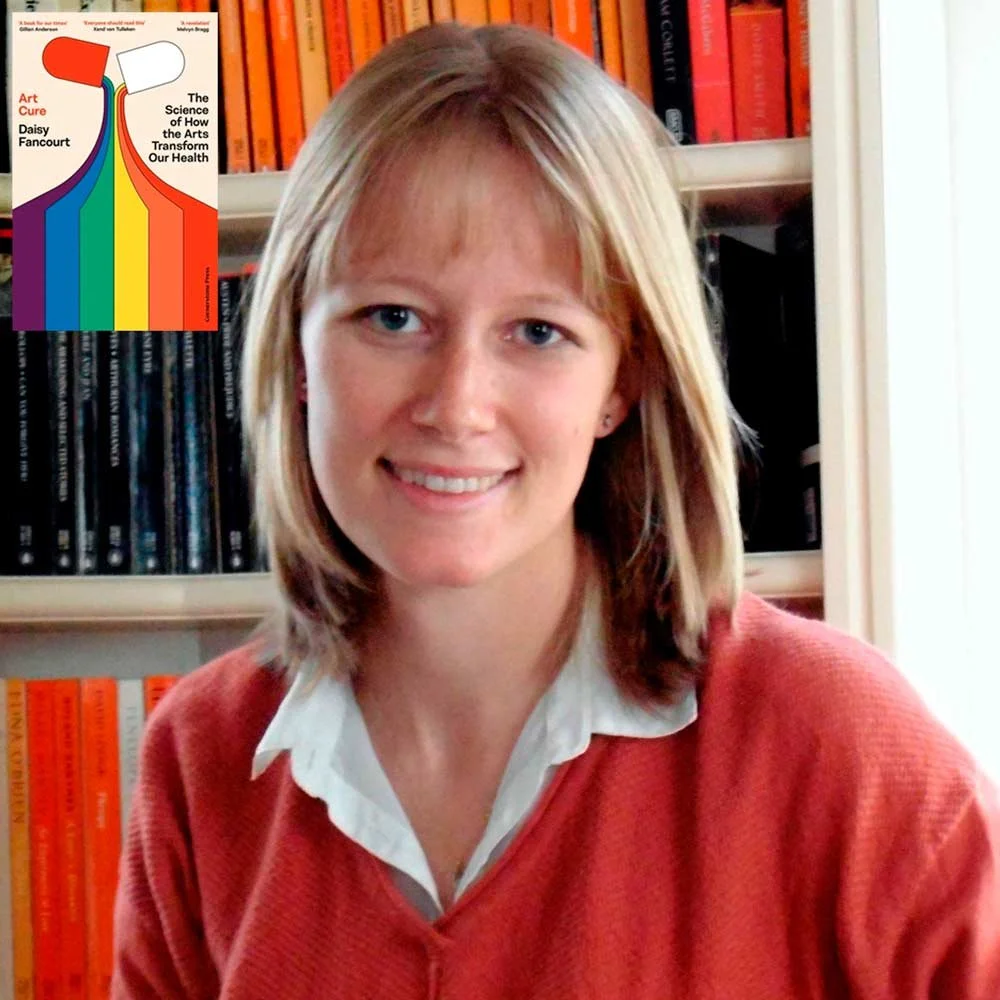
Today’s guest is Professor Daisy Fancourt — one of the world’s leading researchers at the intersection of arts, health, and science. She is Director of the World Health Organization’s Collaborating Centre on Arts and Health, and Head of the Department of Behavioural Science and Health at University College London. She’s the author of the book Art Cure: The Science of How the Arts Transform Our Health.
Her work has helped redefine how we think about the arts — not as optional enrichment, but as a vital component of human health, alongside exercise, nutrition, sleep, and social connection. Drawing on neuroscience, psychology, immunology, and large-scale population studies, Daisy has shown how engaging with music, visual art, dance, theatre, and literature can measurably improve our mental, physical, and social wellbeing across the lifespan. She has advised governments, the WHO, and health systems around the world, and her research is shaping how the arts are being integrated into healthcare and public policy. Today, we’re going to explore what the science really tells us, why the arts are so powerful for health, and what this means for how we live, heal, and design healthier societies.
THE CREATIVE PROCESS
There are so many threads in what you’re saying, but one that stands out is the idea that art isn’t separate from everyday life. It’s embedded in how we design systems, solve problems and make meaning. In that sense, we really are all artists because all of our lives are shaped by art and design. Whether we think of ourselves as creative or not, on a societal level most of the world’s important problems—like the environmental crisis, political problems or economic issues—when you come down to it, they’re actually problems of design. So that makes the arts accessible and essential to everyone.
What’s striking is that many professional artists don’t even describe their work using artsy vocabulary. When you sit down and actually listen to them, they often use the vocabulary of architects or engineers. They talk about form and solving structural or emotional problems, how to shape a story, a composition or an experience. It becomes technical when you get into the profession of it: what was the structural arrangement that I needed to solve in the plot of this novel or this musical composition?
That’s a door that’s open to all of us. But what I think is really interesting and surprising when you hear Russell’s story is how art saved him. This is something that I’ve reflected on a lot too. It might not come to all of us, that art will save our life in that way. I’ve always believed that art is linked to survival. Freud said that “the artist escapes insanity by creating their own reality.” I think that it’s more a question of survival.
When you watch animals, you could say they are programmed to do the things they do—whether it’s the camouflage, the courtships, the songs, the dance of starlings in the sky to ward off predators, but I think their art is bound up with their daily life, though we might not call these works of art. But when you talk about community expressions, as you write about in your book, or theater... that’s art bound up in daily life, bound up in education. When we take art out of things, when we say art is a business commodity, a product that needs to be sold... and other people do other kinds of jobs but there’s no artistry in it, that makes us unhappy.
DAISY FANCOURT
Often there’s something that we feel we should do as a kind of leisure activity or hobby if we have enough time or money. This is so fundamentally different to how humans engaged with the arts when we look back thousands of years.
It just was part of the everyday, and I feel like that’s a major loss within contemporary societies, particularly in the Global North where we’ve created this artificial separation. Even when we think about are the arts good for us? most people will tend to think about things like, yeah, I feel better, or I enjoy the arts. They’ll think about quite surface-level wellbeing experiences. But actually one of the things that I try to really point out in the book is that the arts have these very deep-seated large effects on our health and wellbeing.
THE CREATIVE PROCESS
This is something you’ve devoted your life to—not just the creative process, but the science. You describe a turning point in your book where you chose science, but you have a foot in both worlds. Sometimes people know the theoretical side but they don’t know it as practicing artists. You can speak with experience, but then you’ve turned towards sharing with the world, which is a a sacrifice too, to not just focus on your own art but on celebrating the arts generally and making them accessible to all.
FANCOURT
We have this kind of false dichotomy sometimes between arts and science, this feeling that you have to pick, but I actually increasingly feel like we should be able to do both all the time. We actually now know a lot about the biological mechanisms that the arts activate. So when we feel happy when we engage in the arts, that’s not just ourselves willing ourselves happy; that’s because the arts are activating reward networks within our brains. Studies like this are so exciting because they’re showing this is not just a placebo effect.
THE CREATIVE PROCESS
Before we go deeper into the conversation, I believe you’re going to share passage from Art Cure you’re going to share with our listeners?
FANCOURT
Russell stood with his hand on the door, wondering whether to go in. It just wasn’t his scene. He was here only because his doctor had told him to come.
It had started with a stroke. He’d been walking home from work when the blood supply to the base of his brain had been blocked and the world careened sideways. He’d had to relearn to walk and talk. There had been months lying in bed staring at the ceiling and panicking about his future. He’d developed back pain so bad he couldn’t sit up. He’d lost his job, his relationship with his partner fell apart, he couldn’t play with his son anymore, he put on weight, he couldn’t sleep. When he did, his breathing kept stopping, so he had to wear a mask over his head at night blowing air into his lungs to keep his airways open. His doctors prescribed dozens of pills, but new problems kept accumulating. He felt himself spiraling down into depression.
When his doctor first wrote the prescription for eight weeks of art classes, Russell thought for a moment that it was some sort of joke. How was art supposed to help? But he didn’t feel he had anything to lose anymore, so he opened the door.
The first class wasn’t as bad as he’d expected. He didn’t paint, he just watched the others in the class. But somehow just being around the paints, the colors and the calming atmosphere had an impact, and on his way home, he noticed his breathing was slower and deeper and he felt a bit calmer than he had walking in. The next week wasn’t as daunting. He recognized a few of the other people. Again, he didn’t do any art. But that night, he couldn’t sleep, so he snuck outside and sat in the shed in the garden doodling little caricatures of the people in the art group. In the third class, he picked up a paintbrush. Russell’s still not sure how things escalated so rapidly after that, but a few weeks later, he found himself standing in front of the art group to announce an idea he’d had: to paint portraits of them all.
I first met Russell at 6 a.m. in the basement cafeteria of a Premier Inn in Manchester. We were both waiting to go on television for the breakfast news show to talk about a new proposal to roll “arts on prescription” across the UK’s National Health Service (NHS). Over cups of instant coffee, I tried to grasp the magnitude of the experience he was telling me about.
At the next checkup, Russell explained, his doctor was pleased with his progress. His mood was improved and his pain levels were lower. Even his blood pressure was better. The art class gave structure to his week and he found himself looking forward to it. At the following checkup they started to review his medications—the doctor didn’t feel he needed as many. His sleep was better too.
As his portraits neared completion, Russell approached the Museum of Gloucester to ask if they would allow him to host an exhibition of the paintings in their café. He called the exhibition We’re All Mad Here. His classmates and his doctor were among those who attended. He received his first commission shortly afterward; a nurse who had come to the exhibition wanted him to paint her children. That was just the beginning.
In the decade since, Russell Haines has exhibited his artwork all around the UK, from Gloucester Cathedral to the Tower of London. His pieces sell for thousands of pounds (if you’re fast enough to get your hands on one). He’s been leading his own classes back in the community too, and his doctor has been referring more patients to him. He doesn’t take any pills nowadays. He hasn’t even had to visit his doctor in over a year.
I asked him, “How great a change do you think those art classes actually made for you? How big of an impact are we talking?”
He didn’t miss a beat.
“They saved my life.”
Do you remember the first album you bought? The photograph you loved so much you framed it? The show you spent hours queuing to get tickets to? The poster you had above your bed when you were growing up? I probably don’t have to try too hard to convince you that we are all—in one way or another—consumers of the arts. Our tastes may differ: Your music may be my noise, my street art your graffiti. But we all engage. In fact, we do more than that. Have you ever hummed a made-up tune in the shower? Doodled in your notebook when you should have been working? Taken a photo on your phone? Danced (however awkwardly) at a party? Improvised a bawdy limerick? However much you might resist the labeling or protest that you’re not “artistic” or “creative,” the evidence is to the contrary. We are also all producers of art. We are a planet of eight billion artists.
Tangible evidence of our artistic prowess as a species can be traced back forty thousand years. Around this time, a remarkable evolutionary development meant that Homo sapiens became capable of performing three advanced cognitive processes at the same time: mentally conceiving an image, intentionally communicating this image and attributing meaning to it. This resulted in the first physical examples of art that still survive today: stone figurines, bone flutes, animal skin drums, cave paintings, heel prints in rhythmic patterns. Art subsequently accompanied human beings as they spread across the globe. Every culture and society has art. We use it to express every emotion, every experience: love, hatred, war, politics, peace. Art awakens our passions, causing public outcries, protests and riots. Humans idolize artists as demigods and make pilgrimages to see them perform. Artworks are preserved for thousands of years to enshrine their beauty, bought for more than their weight in gold and sent for preservation on the moon. Art is so incomprehensibly beautiful it has inspired more art about itself. On average, we read seven hundred books in our lifetime, watch five thousand films and listen to 1.3 million songs. Over three hundred million of us attend a live music event each year. The global cultural sector provides nearly thirty million jobs worldwide and has an estimated worth of $4.3 trillion a year. As a species, we are obsessed.
Yet despite this obsession, for most of the past forty thousand years we have failed to reach a consensus and provide a coherent scientific answer to a fundamental question: Is art good for us? Not in the vague sense of being positive and pleasant, but actually having tangible, meaningful effects on our health?
THE CREATIVE PROCESS
Thank you for sharing that. Art is what makes a life meaningful in this broader context. When we look back at the arc of history, art is how we define who we are. You talk about the cave paintings in Lascaux or these songs that we remember even years later, or the great works of literature. What else do we know about these societies except these works of art? We have to piece together the stories from what remains, and it’s the art.
FANCOURT
It is. And I think it’s interesting that singing is thought to have evolved about two hundred thousand years before language did as a way of supporting group bonding. One of the things that people often think about with the arts in terms of benefits is that group opportunity. The arts is a way of reducing loneliness or providing people with social connection. Actually, people who engage with others doing art, like singing, bond faster with other people than if they just go chatting or if they go to the gym, for example. So that evolutionary purpose of the arts in supporting group bonding is something that we still see manifested so strongly in contemporary societies.
But you’re right, there were these points in society where we used to just get the arts organically, whether that was through faith or in schools, for example, or even as a part of work. Singing used to be part of people’s way of managing day-to-day jobs. But actually often now we’re seeing those opportunities fading away. We’re seeing that people might not go to church anymore. Arts are often not available in schools anymore. In the US there are two million children who don’t have access to the arts through their schools at all. And we also see that lots of the community-based arts opportunities—like arts venues, community arts spaces—many of those have shut over the last decade through funding issues in many countries around the world. So these easy opportunities to engage are actually slipping away. It can be harder for people to have that opportunity for creativity.
THE CREATIVE PROCESS
Talking about the physiological benefits... you discussed in your own field of study and the immunological benefits, slowing down time or slowing down our breath, releasing ourselves from pain. It was great to have these studies put out there in a digestible way that anyone can have access to and share with their friends and family. You might be going through a terrible illness, but the arts can lift you and you can will yourself to connect with a sense of wellbeing.
FANCOURT
We actually now know a lot about the biological mechanisms that the arts activate. So when we feel happy when we engage in the arts, that’s not just ourselves willing ourselves happy; that’s because the arts are activating reward networks within our brains affecting things like dopamine release and uptake, which means that there are actually hormones in our brains that are increasing that happiness.
Similarly, when we think about the arts relaxing us, again, that’s not just perceived relaxation. We actually know from studies now that that’s about reductions in stress hormones like cortisol and also reductions in autonomic nervous system activity so that our heart rates slow down and our breathing slows when we’re engaging in relaxing arts activities. And in fact, the research that I’ve led in the UK at University College London, we’ve looked at immune function in particular, showing that arts engagement actually helps to reduce levels of inflammation in the immune system. This is so important because inflammation is not only related to physical illness, but also to mental illness symptoms like depression. One of the reasons that the arts help to reduce those low symptoms is because they’re reducing the biological inflammation that is associated with depression. Studies like this are so exciting because they’re showing this is not just a placebo effect. It’s not just what we wish was happening or want to happen when we engage in the arts. These are deep-seated biological processes that the arts activate.
THE CREATIVE PROCESS
I think you have more of the freedom when you have a hobby, and then when you devote your life to it, you do get those moments. But so many artists and maybe it’s even scientists, when they have to do it, they have to write the grants, or fundraise for the filmmaking… If you’re on a film set and you have schedules and every hour costs so much, the freedom is sometimes taken out of it. How do you find that delicate balance?
FANCOURT
Something I come to in the closing chapters of the book is this dichotomy. What we actually see in the research is that professional artists tend to have higher levels of wellbeing than the average population, but also higher levels of stress and anxiety. I think many professional artists probably can attest to this.
Part of the issue is that we really devalue the arts in society. So many artists aren’t paid well or they don’t have permanent contracts or job security, so it can be a very precarious way of life. Actually, for lots of professional artists, their lives are depending on their persona now, their visibility, their following. It can be a lot of pressure for artists to actually keep that up as well as investing in the craft itself. So I do think that we could perhaps be designing our societies better to value and support artists.
But it’s also just that warning about when something stops being your release, your hobby, your time away. When it becomes the way to earn your income, then of course it can bring that stress with it. In fact, some of the professional artists I know... one of them is a professional violinist, but when he retired from being a violinist, he put his violin down and he took up the oboe for the first time because he said that the violin for him was always going to have that work association. He wanted music, but he wanted it to be a separate thing, therefore it was about a new instrument and a new challenge. So I think often having a separate artistic hobby alongside a professional arts career can be what artists ironically need.
THE CREATIVE PROCESS
Balancing innovation, creativity, curiosity... that itself becomes an art form. There are real benefits to being an amateur or just adding new quivers to your bow all the time. And also being able to improvise. That’s something else that a lot of us have forgotten to do. People have a fear around trying something new that you aren’t an expert at yet, doing something on the spot. But I find, and I think it’s really important if you’re talking about the arts as a pathway to feeling alive, that being open to the failures or being open to just discovering who you are without all the planning is also a part of the healing benefits of the arts.
FANCOURT
It is, and that comes back to this notion of play, doesn’t it? When we are kids, we are so good at trying new things, not being worried about whether we do them well or not, doing it for the enjoyment of it and being imaginative, getting really lost and immersed in imaginary play. But as adults, we tend to lose that. It’s such a shame because actually our brains need this.
There’s a phenomenon called predictive coding, and it’s about whether our brains have got the ability to be able to anticipate even unexpected things that might happen in the world and respond really well and appropriately to them. It’s a big marker of resilience. But actually, unless we’re giving ourselves those opportunities for play, for creative engagement, imagination, improvisation, we are not actually honing that skill within our brains. That’s where acting, festivals, getting involved in arts and crafts, being involved in stories... writing stories is so important for actually building that brain skill of predictive coding.
THE CREATIVE PROCESS
I don’t want to talk about us as code. I know that that’s part of the scientific lens of things. I know that going down to DNA, that we are code and some people are talking about silicon consciousness. I don’t want to think about myself as a predictive text engine, but then I hear different technologists and philosophers talking about us as a predictive text machine. If you take that one step further... okay, AI has intuition. I think that’s fine too, but I thought, man, that was the last domain that I thought was ours. You can take our jobs, take everything, but intuition, improvisation... that’s ours.
FANCOURT
But I think that this is where we’re perhaps going wrong in the way we think about AI. There are so many of these debates recently about can AI be trained by using people’s novels and using their music? But the question I keep coming back to is: why do we want to hand over something as fun as creativity to AI? Can’t we get AI to do the jobs that aren’t creative that we don’t really want to do, so that we actually get freed up to do more of the creative things ourselves? Surely that’s what we as humans and society want to be using our time for.
THE CREATIVE PROCESS
It connects us with these people from around the world who we might not ever get to meet. That is really invaluable. With so much of our difficulties that we do go through, we forget somebody else had this and even worse, and they made it through and here’s their story. You can experience it. So there’s a physiological element of this. Of course, you discuss dance and music and how it can boost the immune system and longevity. Let’s go into that and how we can make exercise more a part of the arts as well, or recognize that the two exist side by side.
FANCOURT
There is really exciting research now coming out showing that arts engagement actually affects the expression of our genes. And there are particular patterns of gene expression that are called epigenetic clocks. Essentially what these show is whether we are biologically younger or older than our chronological age. So even if you’re someone who’s, let’s say sixty years old, are you actually biologically maybe only fifty or fifty-five, or are you actually older? This depends on our lifestyles and what activities we’ve engaged in and the environments around us.
What’s really exciting is that the research coming out, including from my team, is showing that people who engage in the arts are actually biologically younger—even when we’ve taken account of the rest of their lifestyle and their demographics—and they actually age slower biologically over the following years. This is actually starting to open up these conversations that arts engagement is really fundamental to our longevity, to thinking about how we’re aging healthily. In fact, there are over a dozen studies now showing that people who engage regularly in the arts have longer life expectancies. Even when we’ve taken account of things like their wealth, their education, the other behaviors in their lives that could explain that association.
THE CREATIVE PROCESS
I want to also not ignore your area of psychoneuroimmunology. Could you define that for us?
FANCOURT
Psychoneuroimmunology is a field of science that looks at the interconnection between our psychological thoughts and experiences in life and our biological function. Essentially this field has demonstrated that when we have experiences in our lives, they’re not just perceived neurologically, psychologically, but actually there are correlates in terms of our biology: our stress hormones, our immune function, the expression of our genes. And in reverse, those biological functions can actually alter the way that we think and act. So this field of research is really exciting because it gives us objective biological data alongside our psychological experiences and brings the two together.
THE CREATIVE PROCESS
We didn’t talk about your own experience of music. Let’s go back to what brought you to the arts. Tell us about that background, your early teachers, your two paths, your two worlds.
FANCOURT
Like many people, I’m someone that couldn’t really pick between arts and science. I had a childhood that was really rich in the arts. Both my parents are professional musicians, so I always assumed that was the route I would go down. I actually went off to university—I went to Oxford University and read music initially—but I immediately felt like I was missing the science in this as well. So I was so lucky. I got part of a training program within the National Health Service in hospitals, which was focused on trying to bring arts programs into clinical care.
I trained on that alongside my degree. And when I finished my degree, I got what I thought was my dream job: working in a hospital in London at Chelsea and Westminster Hospital, designing a performing arts program that would sit within the medical offering of the hospital. It was the most incredible experience because I could see firsthand the benefits that the arts have—from reducing pain amongst burns patients in intensive care, to helping people who’d had a stroke to regain their physical function through things like dance, or helping dementia patients to remember things from their childhoods.
I kept seeing that the arts were seen in the hospital as entertainment by some people. The really important benefits we were seeing for health weren’t always something people were aware of. So I actually decided to leave the hospital and pursue science. I did a lot of retraining. It was not a straightforward process but I then eventually earned a PhD in psychoneuroimmunology.
I have worked since as a scientist, trying to bring the evidence to understand how and why the arts have these benefits for our health. Actually, I’ve always been really heartened by how much the medical community is embracing this space and recognizing this isn’t about the arts replacing effective medical treatments. It’s about arts helping to fix gaps that there might be, that might be around rehumanizing clinical environments, supporting aspects of wellbeing that go beyond what a pill can offer or helping to tackle the mental or physical components of care alongside other kinds of treatments. Like I said, I’ve very much seen this willingness from the medical community to engage in those discussions and to work collaboratively on research studies that can actually ascertain if the arts are an effective tool to achieve those different outcomes.
I was really lucky. I had very inspirational music teachers all the way through, whether that was violin and piano teachers and also music teachers all the way through school. For me, they really ignited this passion for the arts, this feeling that you can do anything with them, that any piece of music that you want to play, that any opportunity that you want to have with others to create music as well... that improvise equality as well.
So I think that was, for me, a really lovely opportunity. It’s one like with my own children now that I’m trying to find: what are their creative niches? Because the truth is we can’t force someone into a creative hobby that isn’t going to fit their personality. That’s why in the book I am constantly making the point: this isn’t about giving you a pill, like a prescription for what you have to do every single day. It’s about giving people the knowledge and the tools to write their own prescription for the arts activities that they are going to really love, and they’re going to have that passion for.
THE CREATIVE PROCESS
Exactly. There are no rules. Just be. Once you’re around it enough, you’ll find your own rules and that’s best. And then once you find your own rules and you make them, you’ll find, oh, this works. Now I have to try something else. It’s just about being open to change. And I think that makes us, as you say, resilient for life.
We talked a little bit earlier about how we find beauty in nature, and I feel that those are really bound up. In some ways the arts are our way of reproducing the beauty we find in the world but making it something more personal and human that we can understand. Maybe it’s our way of understanding nature, but we all have this sense of wonder of just even looking at clouds in the sky or dust swirling in the sunlight. There’s so many moments of beauty. Can you share a memory or moment where you felt that deep connection with the natural world? I mean, how is that part of your daily arts practice and reverence?
FANCOURT
Well, I love running and hiking, so for me it’s about hiking. I love it when I can get away into mountains and you get that really big center perspective then of looking down on things. Something that I find really lovely is going back to hills or mountains that I’ve been to before, and just seeing how seeing them in a different light makes them a completely different image. It’s a completely different artistic experience of looking on nature in that way. Just from the changing light, the changing seasons. So for me, that gives me that sense of landscape that sometimes you can try and recreate by going into a gallery and looking at landscape paintings, but it’s something that you can see yourself for real by going out and having those moments almost where you’re taking mental photographs of those views that you’re seeing.
THE CREATIVE PROCESS
Artists sometimes have a heightened sense of reality and a way of holding still that beauty. But talking about this is like talking about our human connection with ourselves and others and how we communicate with our interior lives and others. What’s really been in the last few years... as we discussed, but it’s something that we all have to consider... is how AI is affecting that. How AI is affecting the art we make, but also the lives that we live, and increasing that sense of isolation or connection sometimes. What are your broader reflections on it? How do you protect yourself? How do you embrace certain elements? What do you tell your kids?
FANCOURT
My kids are very young, they’re only toddlers. So I’m very lucky I’ve not got to be having these kinds of discussions yet with them. But personally, I’ve been starting to embrace AI for the kinds of routine jobs that I don’t find creative. And for that, I’ve found it a useful tool. But I’ve been trying to save the jobs that are creative because those are the ones that I really love doing. I would never be getting AI to write chapters of a book because that’s been the greatest joy in writing this book. So I feel like for me it is actually about safeguarding the time for the creative process by using AI to try and tackle the non-creative tasks in my life.
THE CREATIVE PROCESS
I think that those are wise words. As you think about the future, the kind of world that we’re leaving for the next generation, the importance of the arts within all of that... what would you like young people to know, preserve and remember?
FANCOURT
I would love young people to be finding their creative niche as young as they can. If we are thinking about how young people spend their time, they’re not going to get the meaning that they really want in their lives from social media, from screens, from phones. They’re going to get it from singing or being in a band with their peers or from putting on a production together, or from writing stories or from painting pictures. Those are going to be the things that give them those moments of meaning. So I want them not to think necessarily, is this high art? Is this professional art? I want them to think, what am I going to enjoy? It doesn’t matter what the music is, doesn’t matter what the dance is. If they’re doing it, that is what I want them to have: that process and that authentic connection with an authentic art form that they really feel they’ve got a connection to.